UAE life & visa · 2026

Living in the UAE: visas, banking, rent and money, explained

The paperwork of UAE life is not hard once someone explains it. This guide walks through your residence visa, Emirates ID, bank account, tenancy, health insurance and the cheapest ways to send money home.

Residence visa

Your residence visa and what it depends on

2-year employment visa30-day grace periodAED 50/day overstayGreen & Golden options

Most expats live in the UAE on an employment residence visa sponsored by their employer, valid for two years and tied to a work permit from MoHRE. The visa is stamped electronically against your passport and comes with an Emirates ID that carries the same expiry date. Because the visa is linked to the job, leaving the job starts a clock: once your employer cancels the visa you have a grace period, normally 30 days, to find a new sponsor, switch to a different visa or leave the country.

Overstaying costs AED 50 for every day beyond the grace period, whatever the visa type, and unpaid fines block a new visa. The overtime calculator includes an overstay fine check. Alternatives to the employment visa include the Green visa for skilled workers and freelancers, sponsored family visas, and the ten-year Golden visa for higher earners and specialists.

Emirates ID

Emirates ID: the card that runs everything

Same expiry as visaNeeded for bank, rent, SIMUpdate changes in 30 daysReport loss to ICP

Your Emirates ID is not just an identity card. It is what you show to open a bank account, sign a tenancy, register a SIM, see a doctor, collect a parcel and pass through the airport e-gates. Applying is part of the visa process: biometrics at an ICP centre, then the card is delivered or collected from a post office.

Keep the expiry date in your calendar, because a lapsed Emirates ID means a lapsed visa. Renewal happens with the visa, and any change of employer, passport or address must be updated on the card within 30 days. If it is lost or stolen, report it to ICP immediately; a replacement takes a few days and the fee is modest.

Visa cancelled? Check your overstay fine.

Free. No sign-up. Takes 30 seconds.

Check my fine →
Banking & WPS

Opening a bank account and getting paid

Salary via WPS onlyAsk for basic salary accountCard APR often 40%+Never bounce a cheque

You cannot be paid in the UAE without a bank account, because salaries must go through the Wage Protection System, a government-monitored transfer that proves your employer paid you in full and on time. Opening an account needs your passport, Emirates ID or its application receipt, and a salary certificate or contract.

Most banks offer a basic salary account with no minimum balance if your salary is above a threshold, typically AED 3,000 to 5,000, so ask specifically for that rather than the premium account the branch will push. Avoid the credit card that comes with the opening offer until you have read the interest rate, which is often above 40 percent a year. Cheques still matter here, especially for rent, and bouncing one is a civil matter that can freeze your account, so never write one you cannot cover.

Renting · Ejari / Tawtheeq

Renting: contracts, cheques and Ejari

1–4 cheques a yearRegistration is mandatory90 days' notice for rent rise5% deposit · photograph everything

Rent is usually paid in one to four post-dated cheques for the whole year, which is why the number of cheques is negotiated as hard as the price. Every Dubai tenancy must be registered with Ejari and Abu Dhabi uses Tawtheeq; without that registration you cannot connect electricity, sponsor family or take a dispute to the rental committee.

The landlord needs 90 days' written notice to raise the rent and can only do so within the limits of the official rent index, and needs 12 months' notice to evict you for their own use or sale. Your security deposit, normally five percent, is refundable if the flat is returned as you found it, so photograph everything on the day you move in. Check who pays the housing fee, the agent's commission, and the chiller charge before you sign; those three surprise more new tenants than the rent itself.

Health insurance

Health insurance and seeing a doctor

Employer must cover youFamily cover is yoursCheck the network firstSick pay set by law

Employers in Dubai and Abu Dhabi are legally required to provide health insurance for employees, and in Dubai the minimum plan must also cover maternity. Cover for your family is your responsibility unless your contract says otherwise. Your insurance card determines which hospitals and clinics you can use without paying up front, so check the network before an emergency rather than during one.

Government hospitals treat everyone in an emergency regardless of insurance. Prescriptions need a UAE doctor's note, some common medications abroad are controlled here, and pharmacies are strict about it. Sick leave pay is set by the Labour Law, not by your insurer; the leave calculator shows the 15, 30 and 45 day ladder.

Sending money home

Sending money home without losing a slice of it

Compare what landsWatch the rate, not the feeOwn-name account onlyKeep receipts

Remittances are where small differences add up fastest. Exchange houses on the high street, bank transfers and app-based services all quote a rate and a fee, and the true cost is the gap between the rate you get and the mid-market rate you see on Google, plus the fee. On a typical AED 3,000 transfer that gap can be anywhere from AED 20 to over AED 100.

Compare the amount that lands, not the advertised fee, and be wary of anything that promises zero fees while quoting a rate two percent below the market. Keep receipts; a bank at home may ask for proof of source of funds for larger sums. The safest habit is to send on a fixed day each month, from a registered account in your own name, through a provider licensed by the Central Bank.

Want to earn some income?

Learn the UAE. Then get paid every month for every friend you bring.

Tutorii teaches you your rights, your visa, your money and your job in the UAE. 20 short lessons in simple English. It costs AED 95 a month — about AED 3 a day. Cancel any time. Every member gets a personal link. When a friend joins with your link, you get AED 38 every month, for as long as they stay.

AED 95

a month · about AED 3 a day · cancel anytime

AED 38.00

every month for each friend you invite (direct referral)

AED 4.75

every month for each friend of your friend (indirect referral)

Tuesdays

paid to your UAE bank every week via MamoPay

3 friends who join = your membership is free, and you still keep earning. You never pay to refer anyone. You only pay for the lessons. You earn only when your friend pays for lessons.

Join Tutorii — AED 95/month

Start learning in minutes

No sales skills needed

EARNINGS
payouts
history

One Link. Real Income.

Master life in the UAE, bring your friends along, and build monthly income that grows with your network.
Tutorii app on an iPhone
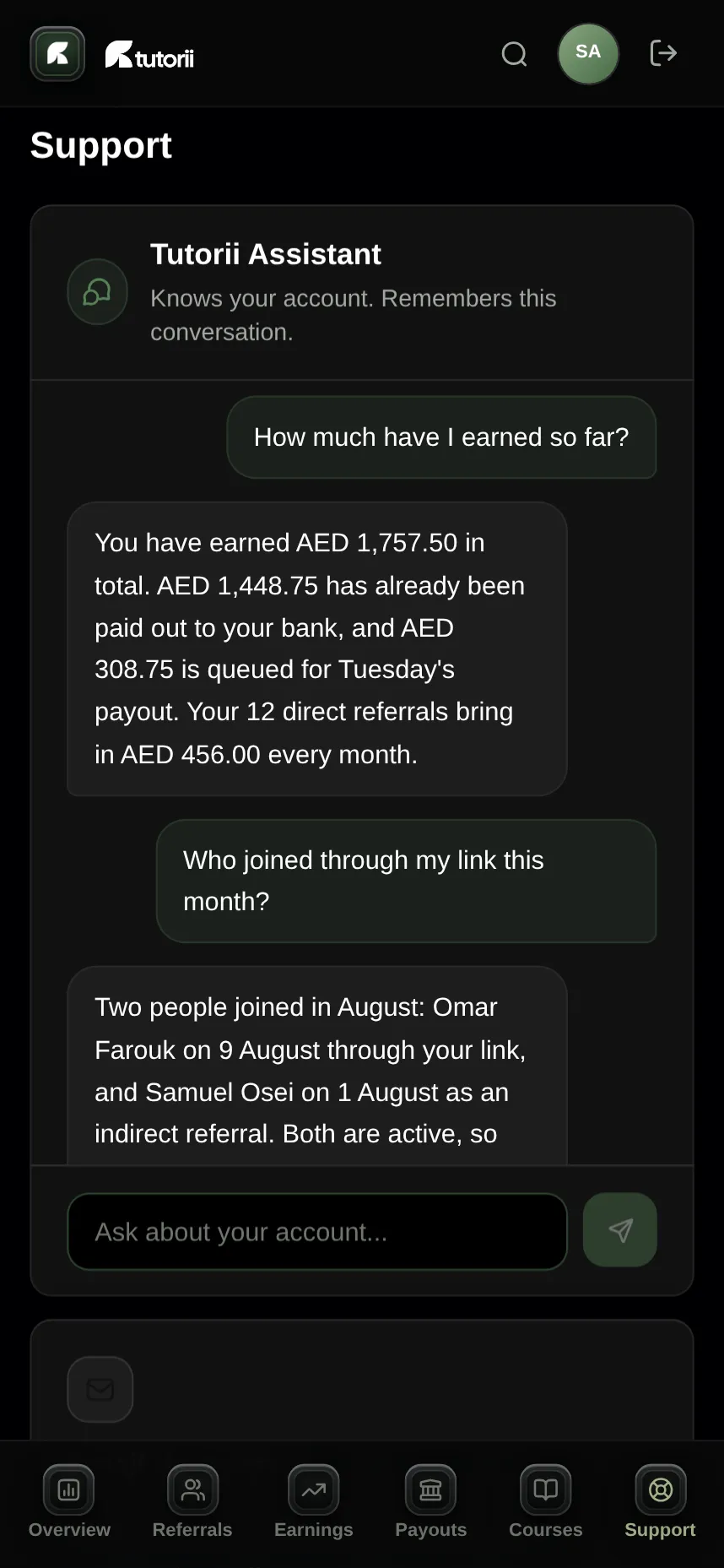
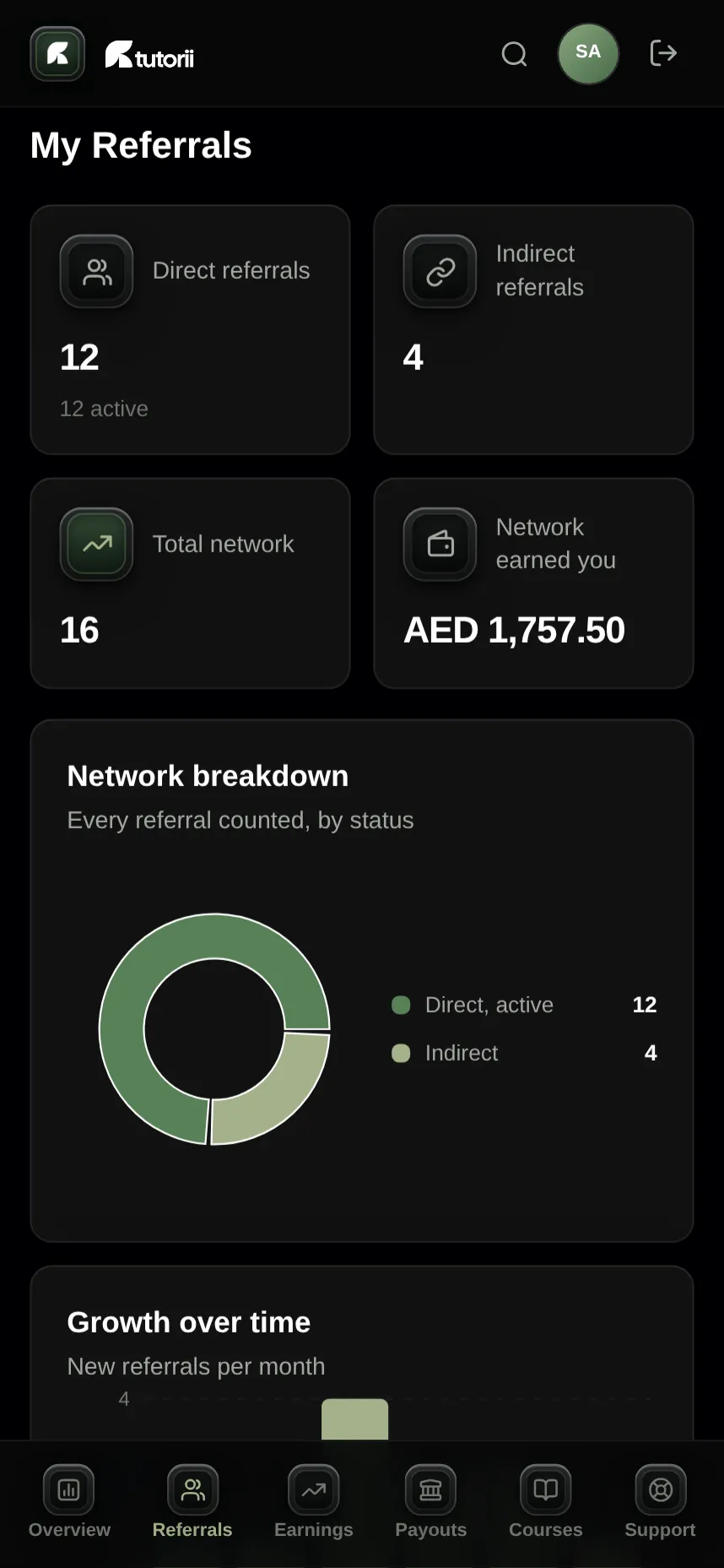
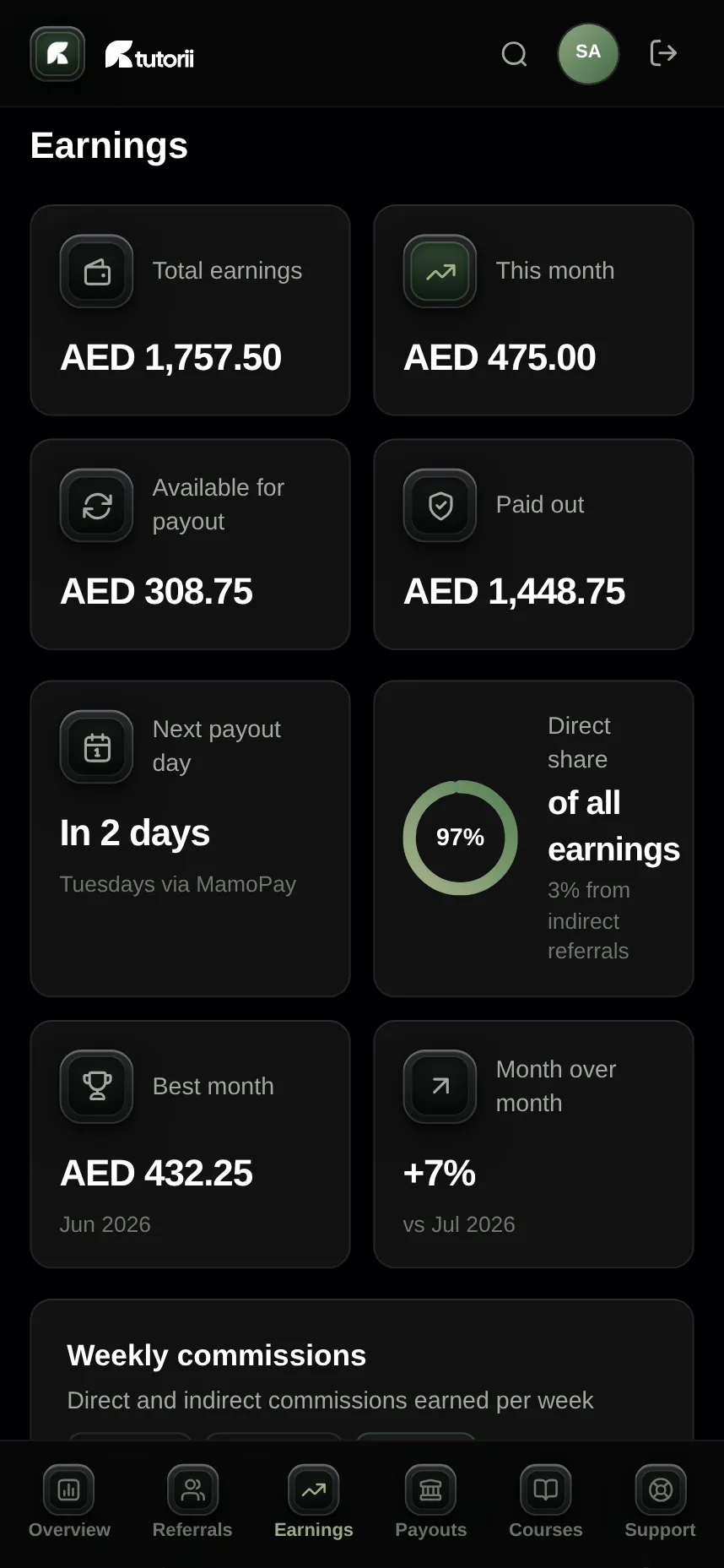
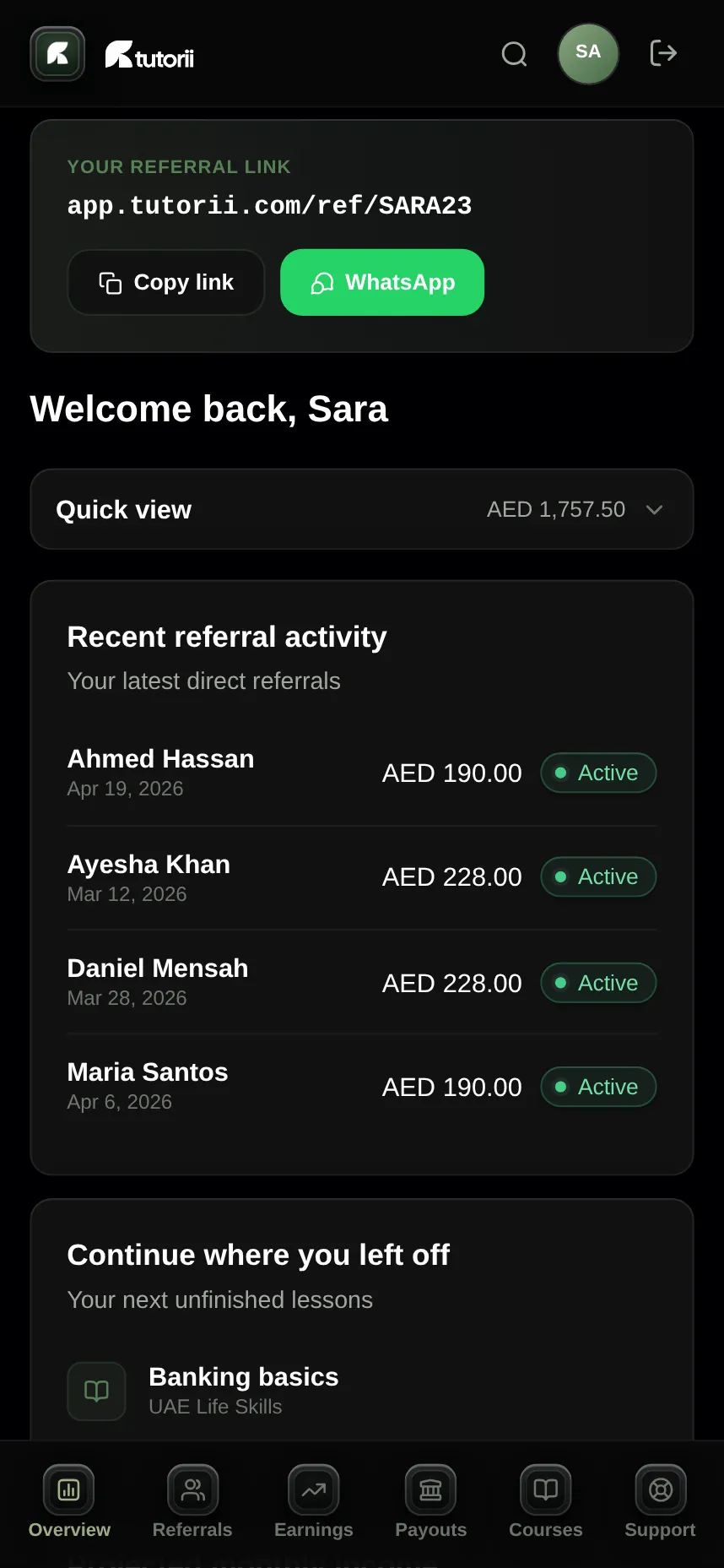
Tutorii assistant answering questions about earningsTutorii referrals screen showing direct and indirect referralsTutorii earnings screen with payout summaryTutorii member dashboard showing referral link and earnings

You learn,
You refer,
You earn

Tutorii app on an iPhone
Tutorii assistant answering questions about earningsTutorii referrals screen showing direct and indirect referralsTutorii earnings screen with payout summaryTutorii member dashboard showing referral link and earnings

Learn, refer and earn

Paid every Tuesday

Join Tutorii — AED 95/month
Tutorii
The subscription that pays you back.
Tutorii app preview

Go deeper

Common questions

How long is the grace period after my UAE visa is cancelled?

Normally 30 days from cancellation for a residence visa. After that the overstay fine is AED 50 per day for every visa type.

Do I need Ejari to sponsor my family?

Yes. A registered tenancy contract, Ejari in Dubai or Tawtheeq in Abu Dhabi, is required for family sponsorship and for connecting utilities.

Is my employer required to give me health insurance?

In Dubai and Abu Dhabi, yes, for the employee. Family cover is your responsibility unless your contract includes it.

The calculators show the number. The course shows how to get it.

Every figure on these tools comes from the UAE Labour Law, but knowing the law and getting paid are two different things. The Tutorii Workers' Rights module walks through final settlements, MoHRE complaints, probation traps and what to sign (and not sign) on your last day, in plain English. It sits alongside modules on visas, banking, career and life in the UAE.

One plan, everything included

AED 95/ month

All 5 modules and 20 lessons · AI assistant for one-off questions · Your personal referral link · Cancel anytime, keep your progress

General information based on UAE federal law and common practice in Dubai and Abu Dhabi. Free-zone rules may differ. This is not legal, immigration or financial advice — confirm your position with MoHRE, ICP or a licensed adviser.

Join Tutorii